

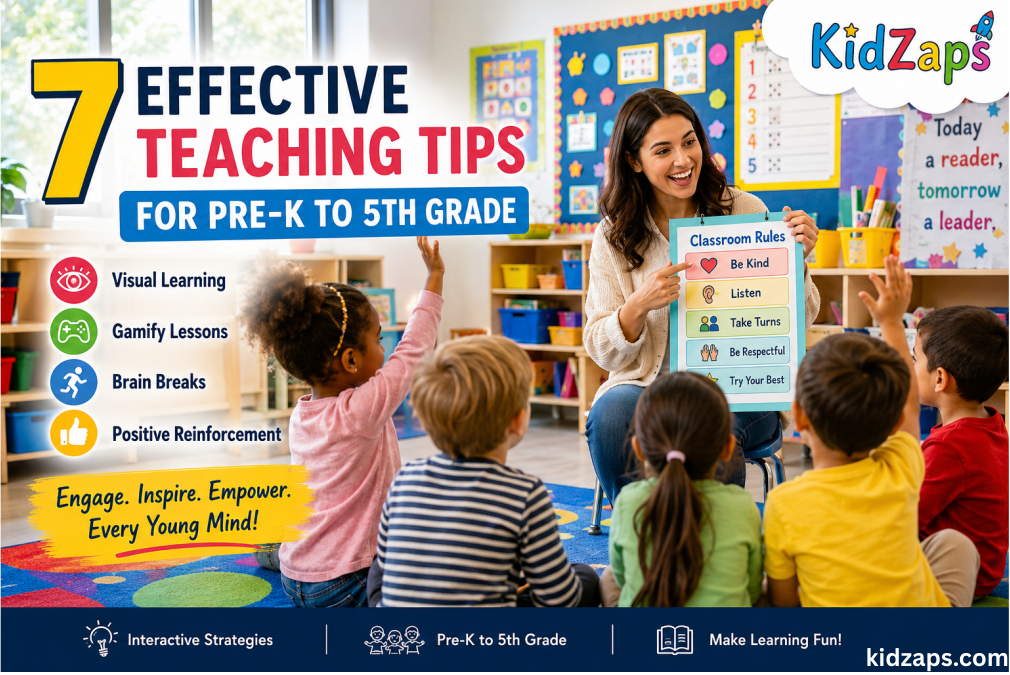
Teaching early childhood and elementary students requires a mix of patience, creativity, and boundless energy. Whether you are managing playful Pre-K toddlers or curious 5th graders, retaining their attention is the biggest challenge. At kidzaps, we understand the unique challenges of early education and have compiled these proven strategies to help you and your students succeed. Here are seven top details:
1. Leverage Visual and Tactile Learning
Young children process visual and physical information much faster than plain text or lectures.
-
Use Flashcards & Props: Incorporate colorful visuals and physical objects for vocabulary, science, and math.
-
Color-Coded Systems: Help students find materials easily by color-coding folders, activity zones, and bins to build organizational skills.
2. Gamify the Learning Process
Turning standard lessons into interactive games instantly boosts participation and reduces behavioral issues.
-
Educational Bingo: An excellent, low-stress way for spelling, vocabulary, or math practice.
-
Classroom Point Systems: Reward teams or individuals with points for answering correctly or showing excellent teamwork.
3. Implement the "Brain Break" Strategy
Attention spans in elementary grades are naturally short. Forcing continuous focus leads to burnout.
-
5-Minute Stretches: Pause every 25-30 minutes for a quick physical activity or stretching session.
-
Kinesthetic Transitions: Have students walk like different animals when moving from their desks to the reading rug.
4. Prioritize Positive Reinforcement
Focusing on what students do right builds their confidence and encourages a growth mindset.
-
Praise the Effort, Not Just the Result: Instead of saying "You are so smart," try saying, "I love how hard you worked to solve that problem."
-
Visual Reward Charts: A classic but highly effective tool, especially for Pre-K to 2nd-grade classrooms.
Conclusion
Every young student learns differently. By mixing visual aids, gamification, and positive reinforcement, you can create a truly dynamic environment where kids are genuinely excited to learn! Remember to be flexible and try different approaches. For more practical classroom advice and innovative educator resources, explore kidzaps.com.